What Is a Kankotri? The Complete Guide to Indian Wedding Invitations in 2026
When you get engaged and start planning your South Asian wedding, one of the first questions guests and family will ask is: "When are you sending the kankotris?"
But if you're new to the term — or you've grown up outside India — you might be wondering: what exactly is a kankotri, what goes into one, and how do you order them without overpaying or making a mistake?
This guide answers all of it.
What Is a Kankotri?
A kankotri is a traditional Indian wedding invitation. The word originates from Gujarati wedding traditions, where the kankotri was the formal written invitation sent to guests to announce the wedding ceremonies and request their presence.
Today, the term is used broadly across South Asian communities — Gujarati, Hindu, Punjabi, Pakistani, and beyond — to describe the full Indian wedding invitation suite, including cards for every ceremony in the celebration.
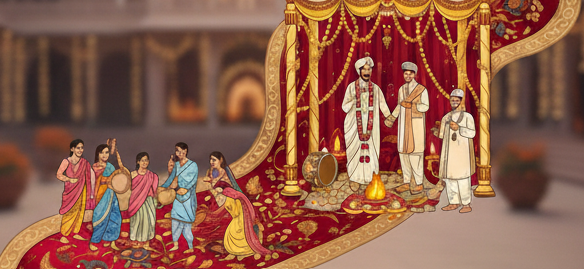
Unlike a standard Western wedding invitation (one card, one event), a kankotri typically covers multiple events across several days: the Mehndi and Haldi pre-wedding celebrations, the Sangeet musical night, the main Wedding Ceremony (Viddhi, Anand Karaj, Nikah, or other religious rites), and the Reception. A complete kankotri suite includes a separate insert card for each function, all enclosed together in a coordinating envelope or presentation box.
What Does a Kankotri Include?
A full kankotri invitation set typically contains several components.
The main invitation card is the primary kankotri announcing the wedding, with the couple's names, families' names, wedding date, venue, and a blessing or shayari.
Ceremony insert cards are individual cards for each function — Sangeet, Mehndi, Haldi, Reception — each with its own date, time, venue, and dress code if applicable.
An RSVP card is optional, but increasingly common for US-based weddings with out-of-town guests.
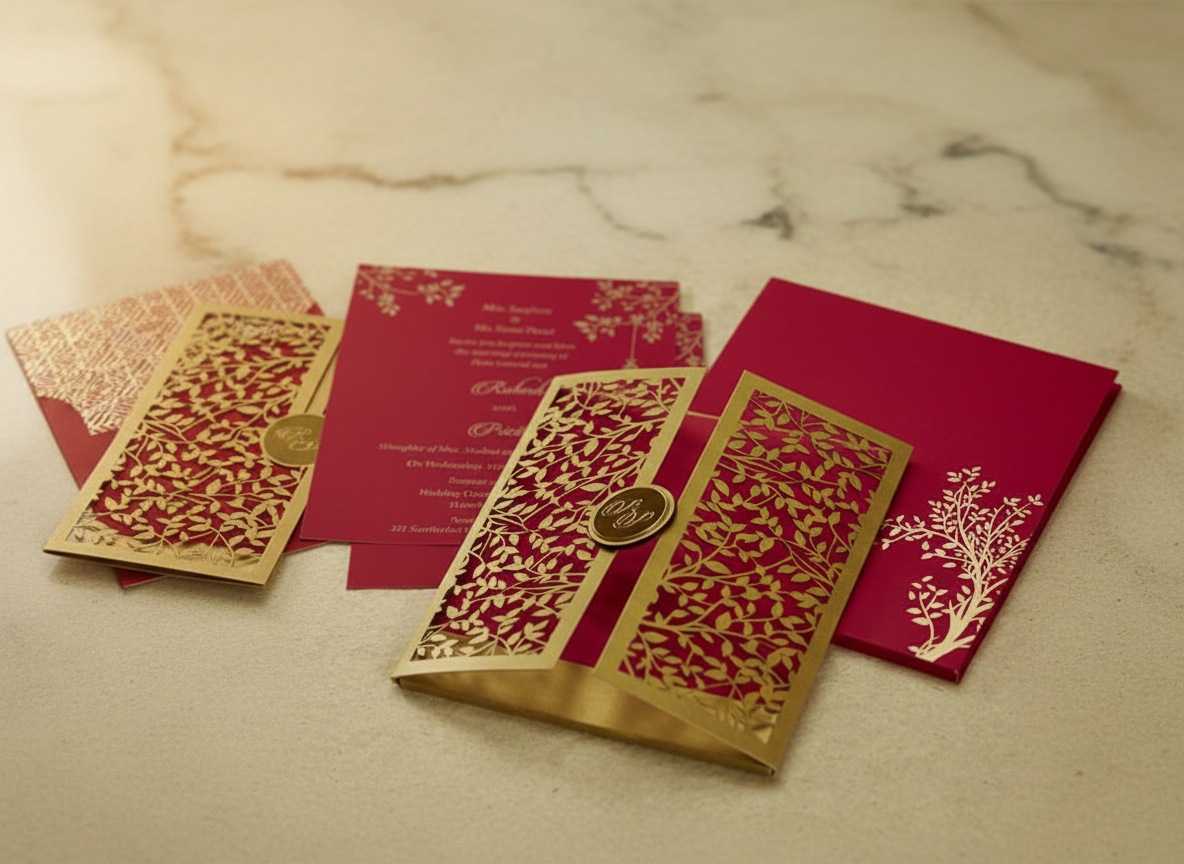
The envelope and packaging holds everything together. Premium kankotris come in foil-stamped boxes, silk pouches, or ribbon-tied folders — and this is often what guests remember most when they open the envelope.
Kankotri Design: Traditional vs. Modern
Kankotri designs range from deeply traditional to clean and contemporary.
Traditional kankotris feature Ganesha or deity imagery at the top, paisley and floral border motifs, rich color palettes in deep reds, magentas, and golds, and classic script fonts in Hindi, Gujarati, Urdu, or English. Optional elements include lotus flowers, kalash motifs, or mango (keri) patterns.
Modern kankotris feature minimalist design with white space, watercolor florals or botanical illustration, neutral palettes in blush, ivory, sage, or dusty rose, and clean serif or sans-serif typography.
Fusion kankotris — the most popular direction for US-based South Asian couples right now — combine both. Think a traditional Ganesha illustration in a modern color palette, or a minimalist layout with gold foil accents.
The right style depends on your wedding aesthetic. If your reception is a grand ballroom with crystal chandeliers, lean traditional. If it's a garden venue with fairy lights, lean modern. Your kankotri should set the right expectation for the day.
How Much Does a Kankotri Cost?
Kankotri cost varies widely based on design complexity, paper quality, quantity, and whether you use foil stamping or premium packaging.
Digital or printable download kankotris cost $0 to $200 as a design fee only. Simple printed cards on basic paper run $2 to $5 per set. Standard premium kankotris are $8 to $18 per set. Foil-stamped cards on thick card stock run $15 to $30 per set. Boxed luxury invitation sets start at $30 and can exceed $75 per set.
For a 200-guest wedding, budget roughly $400 to $1,000 for simple printed cards, $1,600 to $3,600 for standard premium kankotris, or $6,000 to $15,000 for foil-stamped boxed sets.
One tip most couples miss: order 10 to 15 percent more kankotris than your guest count. You will want extras for family keepsakes, last-minute guest list additions, and your own wedding album.
When Should You Order Your Kankotris?
This is where many couples get caught off guard. Kankotri timelines work backwards from your mail date, not your wedding date.
At 8 to 10 months out, choose your kankotri style and begin the design process. At 6 to 8 months out, finalize the design, approve your digital proof, and place your print order. At 4 to 6 months out, receive your printed kankotris and stuff envelopes. At 3 to 4 months out, mail your kankotris — this is the target for out-of-town guests. At 6 to 8 weeks out, follow up with guests who have not responded.
If your wedding involves guests traveling internationally or from across the US, mail earlier rather than later. Out-of-town guests need time to book flights, hotels, and request time off work.
Give yourself at least 8 weeks from design approval to the date you want kankotris in guests' hands.
What to Include on a Kankotri
Every kankotri should clearly communicate both families' names (traditionally the parents of the bride and groom are listed as hosts), the couple's names in English and optionally in the family's native language, the date and time of each ceremony using both the day of the week and the full date, the venue name and full address, the dress code especially helpful for American or non-South Asian guests, RSVP instructions with a phone number, email, or wedding website URL, and optionally a blessing or shayari which adds warmth and cultural depth.
The most common mistakes couples catch during proofing are typos in venue addresses, incorrect spellings of family names, and vague timing ("evening" instead of "6:30 PM"). This is exactly why a digital proof before printing is non-negotiable.
Kankotri vs. Indian Wedding Invitation: Is There a Difference?
Technically yes — but in everyday usage, the terms are interchangeable for most US-based South Asian couples.
"Kankotri" is the traditional Gujarati term and is now widely used across communities as the standard word for a South Asian wedding invitation suite. "Indian wedding invitation" is a broader English-language term that covers the same thing — the multi-ceremony invitation set for a Hindu, Sikh, Jain, or Muslim South Asian wedding.
If you are Gujarati or from a community that traditionally uses the word kankotri, use it. If you are Punjabi, Tamil, or from another community, you may call it your "wedding card" or "invitation suite" — but the format is essentially the same.
How to Design Your Kankotri Online
Ordering kankotris used to mean either flying to India, paying a local printer enormous markups, or settling for generic templates from a stationery website that had never heard the word "Sangeet."
Today you can design your kankotri entirely online, customize every detail, see a digital proof before a single card is printed, and have premium cards shipped directly to your US address.
At My Brown Wedding, our kankotri invitation builder lets you browse traditional and modern templates, customize names, dates, venues, and ceremony details, choose colors and motifs with no design experience needed, select your paper stock and optional foil accents, review a digital proof before we print anything, and receive printed sets shipped anywhere in the United States.
It is the only kankotri builder designed specifically for South Asian couples planning US weddings — with transparent pricing shown upfront and no hidden fees.
Start designing your kankotri free →
Frequently Asked Questions
How far in advance should I order kankotris?
Order at least 8 to 10 weeks before your target mail date, which should be 3 to 4 months before your wedding. For complex designs with foil stamping, give yourself 12 weeks to be safe.
What is the minimum order quantity for kankotris?
Most printers — including ours — have a minimum of 50 sets. Most couples order 75 to 200 depending on guest count.
Can I get kankotris for just one ceremony?
Yes. You can order a single invitation for your Reception only, or a full suite covering every function. Our builder lets you mix and match exactly what you need.
Do kankotris need to be in Hindi or Gujarati?
No. Most US-based South Asian couples print kankotris entirely in English, or use English with a single line of Hindi or Gujarati for the blessing. Write it in whatever language feels right for your family.
What if I make a mistake on my kankotri?
That is what the digital proof is for. Review it carefully with your family before approving. Check every name spelling, date, address, and time twice. Once you approve the proof, we print exactly what you have signed off on.
Start Designing Your Kankotri
Your kankotri is the first thing your guests receive — it sets the tone for your entire wedding before anyone walks through a venue door. Get it right, and it becomes a keepsake your family keeps for decades.
Design your custom kankotri free at My Brown Wedding →
Also budgeting for your wedding? Use our free Indian wedding budget calculator to get a full cost breakdown by city, guest count, and ceremony type — in under 2 minutes.
Related reading: How Much Does an Indian Wedding Cost in the US? · Your Indian Wedding Planning Timeline · How to Choose Your Indian Wedding Theme
Planning your Indian wedding budget? Use our free Indian wedding budget calculator to get a real cost estimate based on your guest count, city, and ceremony types — takes under 2 minutes.