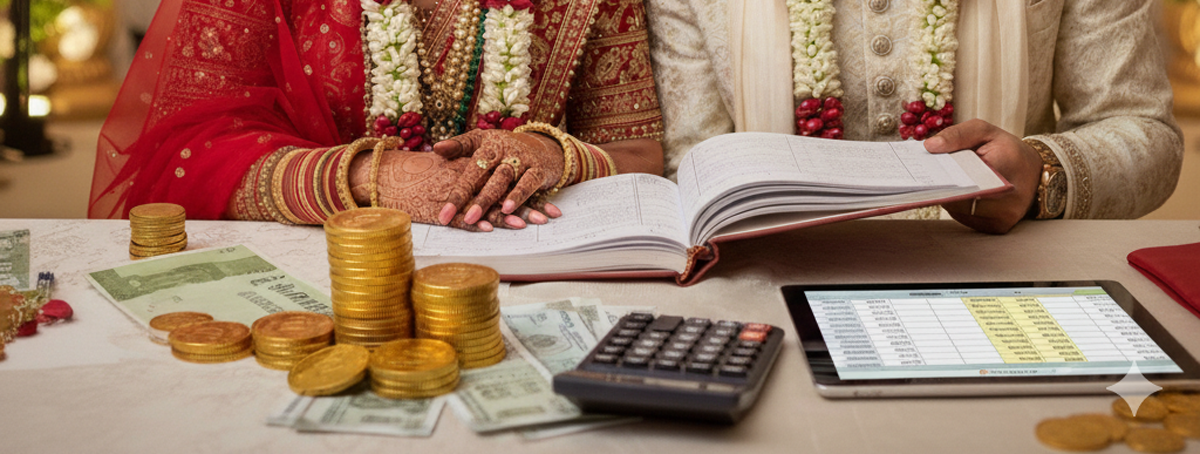
Your Indian Wedding Budget: The First Step to a Beautiful, Stress-Free Celebration
Congratulations on your engagement. As you begin picturing the vibrant colors, the joyful music, and the gathering of loved ones, one question soon takes center stage: "How much will this all cost, and how do we actually keep track of it?"
If you're looking for real dollar figures by vendor and by city, our guide on how much an Indian wedding costs in the US breaks that down in detail. This guide is different — it's about the process. How to set your number, how to divide it across three to five ceremonies, how to keep a large extended family's contributions organized, and how to stop a beautiful wedding from turning into a stressful spreadsheet nightmare.
When Should You Actually Set Your Budget?
Most couples make the same mistake: they start touring venues before they've agreed on a number. Set your budget in the first two to four weeks after getting engaged, before you fall in love with a ballroom you can't actually afford. A budget set early gives you leverage in every vendor conversation that follows — you'll know immediately whether a quote fits, instead of stretching your finances to make it work.
Step 1: Define Your Total Spending Limit
This sounds obvious, but for Indian weddings it's more complicated than a single number. Start by identifying every source of funding:
Contributions from the couple's own savings
Contributions from each set of parents (common in South Asian weddings, and worth discussing openly and early)
Any family gifts earmarked specifically for the wedding
Real prices, updated monthly
See exactly what these vendors charge
Itemized pricing — packages, per-head rates, travel fees — visible only to free members. No sales calls to get a quote.
Financing or a dedicated wedding loan, if applicable
Add these together to get your real total. Write it down. This is the number every other decision gets measured against.
Step 2: Allocate Funds by Ceremony, Not Just by Vendor
Because Indian weddings typically span three to five separate functions, allocating your budget by ceremony first — then by vendor within each ceremony — makes the numbers far easier to manage than one giant combined list. A typical starting allocation across ceremonies looks like this:
Reception: 35–40% of total budget
Wedding ceremony: 20–25% of total budget
Sangeet: 15–20% of total budget
Mehndi/Haldi: 8–12% of total budget
Miscellaneous (transportation, favors, tips, priest fees): 5–8% of total budget
These percentages are a starting point, not a rule. If your Sangeet is the event you care most about, shift the allocation toward it — the framework is what matters, not the exact split. Our free budget calculator lets you enter your own priorities and see the dollar amounts update in real time for your specific guest count and city.
Step 3: Assign an Owner to Every Category
Large South Asian weddings often involve multiple decision-makers — the couple, both sets of parents, sometimes grandparents. Budgets fall apart not because the money isn't there, but because nobody agreed on who approves what. Before you start booking vendors, assign a single owner to each budget category (even if the money is shared). One person should have final sign-off on catering, one on decor, one on attire. This alone prevents the most common source of wedding planning conflict.
Step 4: Track Every Quote, Deposit, and Final Payment
A budget is only useful if you actually track spending against it. For each vendor category, record three numbers: the quoted price, the deposit paid, and the remaining balance with its due date. Indian wedding vendors typically require a 25–50% deposit at booking, with the balance due 30–60 days before the event. Missing a final payment deadline can mean losing your date entirely, so track due dates as carefully as amounts.
If you're using a spreadsheet, keep a running "committed vs. actual" column — the gap between what you planned to spend in a category and what you've actually signed contracts for is where most couples get blindsided.
Step 5: Build in a Real Contingency Buffer
Set aside 10–15% of your total budget as a buffer before you allocate anything else — not after. Nearly every Indian wedding hits at least one unplanned cost: an extra hotel room block for out-of-town family, a last-minute alteration, a vendor travel fee, additional favors when the guest count creeps up. Couples who build the buffer in from day one handle these calmly. Couples who don't end up pulling from categories they can't afford to shrink, like catering or photography.
The Family Conversation Nobody Wants to Have (But Should)
If parents from both sides are contributing, have one direct conversation early about who is paying for what — ideally before any vendor deposits are paid. Common approaches include splitting by ceremony (one family hosts Sangeet, the other hosts the wedding ceremony), splitting by percentage of the total, or one family taking the reception while the couple covers attire and invitations. There's no universally "correct" split in South Asian wedding culture — the only mistake is leaving it undiscussed until a disagreement forces the conversation during planning, when stress is already high.
Common Budgeting Mistakes to Avoid
Booking the venue before finalizing the budget. The venue sets the floor for nearly every other cost — lock in your number first.
Splitting the budget evenly across categories instead of by priority. If photography matters more to you than florals, your allocation should reflect that, not an even split.
Forgetting vendor payment schedules. A vendor who looks affordable today can create a cash-flow problem if three deposits are due the same month.
Not revisiting the budget after each major booking. Update your tracker every time you sign a contract, not just at the end.
Letting guest count grow without updating every category. Guest count doesn't just affect catering — it affects invitations, favors, seating, and often venue tier.
Turning Your Budget Into a Plan
Once you have your total, your ceremony-by-ceremony allocation, and your tracking system in place, the next step is getting real numbers for your specific city and guest count. Start with our free Indian wedding budget calculator, which factors in your city, guest count, and which ceremonies you're hosting to generate a personalized breakdown in under two minutes — no account required to get your first estimate.
From there, you can dig into category-specific guides for real 2026 pricing: what an Indian wedding planner costs, what catering runs per guest, and what photographers in your market typically charge. And when you're ready to make your first impression count, a custom kankotri invitation suite is often the very first vendor booking couples make — it sets the tone for everything that follows.
Frequently Asked Questions
When in the planning timeline should we lock in our budget?
Set your total budget within the first month of getting engaged, before touring venues or requesting vendor quotes. Locking in a number first prevents the common trap of falling in love with a venue or vendor that's outside your realistic range and then trying to make the rest of the budget stretch to compensate.
How do we manage a budget when both sets of parents are contributing?
Have one direct conversation early — ideally before any deposits are paid — about who is funding which ceremonies or categories. Popular splits include dividing by ceremony (one family sponsors the Sangeet, another the reception) or by percentage of the total. Put the agreement in writing, even informally, so there's no confusion once vendor contracts start coming in.
What's the single biggest budgeting mistake couples make?
Booking the venue before setting a total budget. The venue typically consumes 30–40% of total spend, so committing to one before you know your real number often forces you to cut corners everywhere else — catering, photography, and decor usually take the hit.
How much of our budget should be an unplanned-cost buffer?
Set aside 10–15% of your total budget as a buffer from the very start, before allocating the rest across categories. Nearly every Indian wedding encounters at least one unplanned cost, whether it's an extra hotel room block, a last-minute vendor fee, or a guest count that grows after invitations go out.
Is a spreadsheet enough, or should we use a wedding budget calculator?
A spreadsheet works for tracking payments once vendors are booked, but a calculator built for Indian weddings is far more useful up front — it accounts for your specific guest count, your city's typical vendor pricing, and the number of ceremonies you're hosting to give you a realistic starting total before you begin your spreadsheet.
Planning your Indian wedding budget? Use our free Indian wedding budget calculator to get a real cost estimate based on your guest count, city, and ceremony types — takes under 2 minutes.
Real prices, updated monthly
See exactly what these vendors charge
Itemized pricing — packages, per-head rates, travel fees — visible only to free members. No sales calls to get a quote.